Wednesday, September 28, 2016
Mixed Feelings
EVALUATE: What Do You Think?
1. Competition is key to improving school performance.
C. Disagree
This question makes schools seem like a business. Throwing schools out into the free market isn't going to guarantee the improvement of school performance. It will simply make the school system act like a capitalist system: some schools will improve greatly and some will tank. This will especially be true if no regulation and oversight is in place. Improvement of schools needs to occur across the board and not just at the highest level. And we need to stop treating schools like they should be in competition with one another; they should all be performing at a high level regardless of their location.
2. Schools continue to be academically weak, and stronger academic standards are needed.
B. Somewhat Agree
I have mixed feelings about common core. I think it has good intentions but I also feel that it's stifling in its approach. It ultimately ends up doing exactly what it sets out to avoid doing. I feel that academic weakness is a real issue for schools, but it has more to do with teaching to the test, rote memorization and under-qualified and under motivated faculty.
3. Schools do a great job in preparing students for vocational careers.
C. Disagree
Schools do a terrible job at preparing students for vocational careers. I strongly believe in the importance and necessity of history, but I'm not fooling myself that it will make you prepared for a technical trade. Most education is designed to mold the character and critical thinking of students, not to give them skills applicable for a trade.
4. Schools and teachers are very involved with the personal values and beliefs of students.
A. Agree
They are, and they should be. My personal belief is that education is supposed to be about turning students into good people and good citizens. We should be providing values and beliefs that will set them on the right path for the future.
5. Schools emphasize test scores at the expense of other kinds of evaluation.
A. Agree
Schools most definitely emphasize test scores to an unhealthy degree. America loves number (This is despite that fact that we're practically numerically illiterate). You throw a statistic at Americans and they'll think it explains everything. Tangible numbers make us feel like we have a better grasp of the success and failure of schools. But all the truly important stuff about education is impossible to measure. Tests are just bad measures of educational success; they discourage enthusiasm for learning and they takeaway valuable time from instruction.
6. Schools do an admirable job of moving children out of poverty into middle class life.
C. Disagree
Schools are supposed to be the great equalizer, providing equal opportunities for all. But as Jonathan Kozol so vividly depicted, schools in high poverty areas face tremendous obstacles. Very few people coming through them ever get out.
7. Home schooling is an effective alternative to the typical public school.
C. Disagree
There's a Progressive educational spin to be put on homeschooling. Students get to explore their interest in a more creative manner. But while that may be true, students are missing out on valuable socialization and the resources that come with an actual school facility.
8. Students care about the less fortunate, both here and overseas.
B. Somewhat Agree
Students care about the less fortunate, but it is mostly in an abstract sense. Most students don't do charity work or find ways to raise money or help the less fortunate. And when they do, it tends to be because their parents or teachers coerced them into doing it, or because it will look good on a college transcript. Truly altruistic individuals are few and far between.
9. Competition is key to improving student performance.
B. Somewhat Agree
Unlike competition on the macro level which I frowned upon, competition can be healthy on a micro level. Competition can be a game which can lead to excitement, enthusiasm and commitment. Competing with one's peers, can make some people more interested in doing well. But the competition is ultimately still tied to grades and as long as grades are the most important aspect of education, we're never truly going to see student performance improve.
10. Schools are stronger academically today then they have ever been before.
D. I Don't Know
I can talk boldly and with conviction all I want about all those previous questions, but the simple fact of the matter is that I'm not sure how things are right now with education, or how things stand compared to the past. I can't tell how much of my feelings towards the problems with education are due to the cultural mentality that exists as a result of A Nation at Risk, and how much of it is due to genuine flaws. I know there are definitely problems, but I couldn't say if these are problems that were already in place (perhaps for decades even before now) or more recently occurring. I also couldn't say how much of it is due to failed policy decisions like No Child Left Behind and how much of it is due to the issues NCLB was attempting (terribly) to fix. My instinct is to say "no, we're not academically stronger", but part of me thinks that this is inaccurate and that things have been this way for a long time.
Bumper Sticker
ENGAGE: Warm UP!
I could see the bumper sticker ("SCHOOL: The place for…") going two very different ways; one is very positive and the other extremely negative. The bumper sticker could end with something like "The place for creating our future leaders", or "The place for molding our future citizens". But it could also go in a very different direction: "The place for indoctrinating the clueless masses" or the "The place for maintaining the status quo".
There are two distinct schools of thought among the masses about schools and education. The first is that although schools are flawed, they're important. There are hardworking teachers trying to provide quality education in spite of monumental challenges, and students will ultimately gain valuable social and intellectual skills. We know schools are kind of a mess, but that does not take away from how invaluable they are.
The second view is far more cynical. It questions why more basic life skills aren't part of the curriculum (i.e. financial skills like doing your taxes). It finds little value in what is being taught, and sometimes views it as a tool for social control. The role of schools from this perspective is to keep the masses complacent and incapable of questioning social, political and economic ills.
I fall somewhere in between these two camps. I'm no conspiracy theorist, but schools (especially my subject area, social studies) were created as tools of indoctrination and assimilation. The trend toward critical thinking and inquiry is a more recent phenomenon, and, even then, only a select number of teachers are actually attempting to instill this into students. While I'm idealistic about education and what it can achieve, I'm not blind to the day-to-day realities. It's tough for education to live up to the ideal we establish for it.
As you can tell, I don't sport bumper stickers on my car. There isn't room for ambiguity.
Saturday, September 24, 2016
Sticking to the Status Quo
ELABORATE: Observe and Reflect
Would you support the establishment of the Escalante School? Why or why not?
I have mixed feelings about the Escalante School. On the one hand, it appears to have a very noble and worthy goal to provide an education to those students not being reached. It's attempting to make an education that is more inclusive and fair, especially for minority students, such as second language learners, as well as for low achieving students. Yet the school board may have a point. The language of the school's proposal is pretty generic and vague. And if the services it aims to offer already exist in the public school system (as the board seems to imply), then it may not be necessary to create the Escalante School. The services it wants to provide are valuable, but if they're already in place, there may not be a need for the school.
Why can school boards be resistant to change?
School boards are protectors of the status quo. They need to ensure that the allocation of funds isn't being thrown around carelessly. They wouldn't want to invest money into something that proves to be the latest flavor of the week. They're supposed to counterbalance against radical overhauls. That can be frustrating, but it is intended to keep things stable.
Beyond Our Control
EVALUATE: Complete the Tasks
The tasks for this assignment were a reminder that as high minded as education tends to be in theory, in practice, education is controlled by a number of outside factors beyond both teachers' and students' control.
The matching quiz about school finance is a reminder of how large of a factor money is in determining school success. Property taxes determine school funding, and this is invariably why schools in poorer districts tend to have inadequate resources. Wealthier districts have higher property tax rates which provide all sorts of advantages, which can't be overstated. Educational Adequacy is a reminder of how better funding can eventually achieve results, even if it is just higher test scores.
The school governing quiz points out how education can be politicized and controlled by forces that don't necessarily deserve their authority or who may not have the best interests of students at heart. School board officials can be anybody, and they may not necessarily have any experience or background in education (If you're lucky, they'll at least have children in the school district which will create a vested interest in the well-being of the schools). School boards can dictate what is and isn't allowed to be taught in schools. Considering the disproportionate number of conservative, white, male and relatively wealthy individuals on boards, that can lead to biased, unfair or questionable mandates. Ultimately, as a result, teachers can be prevented from teaching in the way that is most effective or meaningful to them.
Friday, September 23, 2016
We Need to Sort Out Our Priorities
Readings
I previously read the excerpt "Hitting Them Hardest When Their Small" from Jonathan Kozol's Shame of the Nation for another grad class. Kozol touches upon similar topics and themes for his article "Savage Inequalities".
Kozol pinpoints the problems in education back to poverty and economic inequality. Kozol argues that economic disparities create major barriers to the quality of education. These barriers tend to get downplayed or dismissed by more affluent (and typically white) school districts. But the fact of the matter is that if we could overcome issues of funding, we could resolve a lot of issues facing education.
East St. Louis, which Kozol describes in the article, is just one example of schools facing immense, seemingly insurmountable problems. These problems begin beyond the school; the article details the violent rape and murder of a young girl right outside of a school building. Education doesn't seem to matter much when that's what you're facing on a regular basis. The schools don't have adequate funding to maintain the schools, which are dilapidated, outdated, and badly in need of repairs. School days are canceled for safety or sanitary reasons.
As Kozol points out, economic disparities tend to be reflective of racial disparities; poorly performing schools tend to be poorly funded schools, which tend to have predominantly minority populations. This becomes especially apparent when Kozol visits a wealthy, white suburban school in New York. The vast gulf of difference between Rye, New York and East St. Louis is massive. The students of Rye see no obligation to help students in schools like East St. Louis -- they're only concerned with how this will impact them. They may recognize the lack of fairness, but they refuse to act upon this.
****
The article "If we Want Better Education..." by Isaac Saul reminded me of a sketch from the sketch comedy show Key & Peele. In the sketch, Key and Peele imagine what it would be like if teachers were treated and paid like they were professional athletes. A Sports Center-like program dissects and analyzes the latest high profile trades between schools, million dollar pay outs, and the incredible lesson plans of teachers. The sketch highlights how we culturally and fiscally place a higher value on pro athletes than we do on teachers, and how we have a culture with its priorities totally out of whack.
Conversations about increasing teacher pay exist in this context. Teacher salaries are wildly low compared to the difficulties and importance of the profession. Low salaries tend to discourage people from entering the profession, which prevents individuals who would be great for the job from entering the profession.
I'm not sure about increased pay as an incentive to draw talent to the field. I think its ability to act as a catch-all, fix-all cure have been greatly overstated. The sort of people who would consider taking on teaching as a career are a peculiar, specific breed and some people would never think about it in the first place (regardless of pay). But increased teacher pay is ultimately an argument for a shift in cultural mentalities in the U.S. about how we treat and value our teachers. Altering the perception of teachers, and education more generally, is important for creating better conditions for students to learn.
Where's Superman When You Need Him?
ENGAGE: WARMING UP!
The above drawing was my Cartoon Maker-designed response to the quote from the warm up task for this week. The quote is as follows:
“All children are hostages to red tape and fiscal insufficiency.”
—Rosellen Brown, Civil Wars (1984)
The picture I came up with is ultimately a tad silly, but I feel like it does a good job of getting across the central idea of the quote. Sometimes the mundane struggles of being a teacher or being a student can feel like titanic, earth-shaking events.
Saturday, September 17, 2016
New England Primer
This task asked us to make some educated guesses about American educational history based on an excerpt from an early American textbook. My response took the form of a Google Slide presentation.
I actually enjoyed this activity because it allowed me to use some of my background in history. History is built around examining documents, making an analysis of them and crafting an interpretation of them. So I'm glad I got to bring to bear this skill set I have.
Hopefully I haven't extrapolated too much. I make some suggestions about early colonial American education based on the document that may be stretching things a little. But to me, solely based on the document, they made a lot of sense.
The Long Arc of History
EVALUATE: When Did it Happen? (Week 2)
The "When Did This Happen?" Timeline made me realize just how far we've come with our education. The early priorities for education were about stopping Satan from destroying the souls of our youths. While instilling a sense of morality and ethics still has an important place, I think we've come to a fuller conception of why we have schools.
We've also come a long way towards far greater inclusion. America has a long history of excluding women and minorities. Plessy vs. Ferguson and Brown v. Board of Education are reminders of just how systematically our country was at preventing basic rights to African Americans. Title IX wasn't passed until 1972, which demonstrates just how recent some of these changes have been. After all, it wasn't until 1975 that the Individuals with Disabilities Act was enacted.
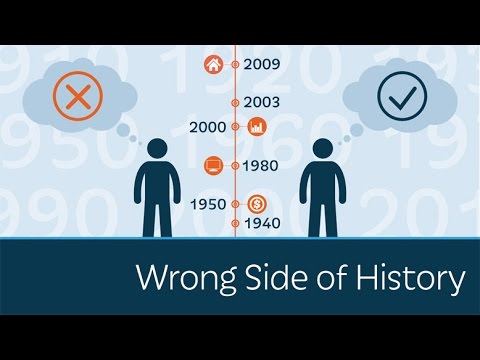
I love how the timeline extends all the way to the year 2100, despite the fact, obviously, that we're nowhere near close to reaching that date yet. It's a reminder that the future is still unwritten. As a future history teacher, I often wonder when considering current events whether my views and stances will "put me on the wrong side of history". If you're going to do something that will look poorly in the eyes of history, you probably need to reevaluate your views or your actions.
The More Things Change, The More They Stay The Same
View Videos (Week 2):
I'm just going offer a few brief thoughts on the videos we were asked to watch.
This video probably gets a little to conspiratorial for its own good (pretty much implying that America is setting itself up to become a neo-Nazi style fascist state (or something to that effect)). But up until those final moments where it completely loses touch with reality, the video is actually making a pretty good point about the nature of the public school system.
The model that America adopted its educational system from, the Prussian model, is obsessed with instilling obedience to authority. It isn't concerned with creating independent thinkers. You can still see the residual effects of this to this day. The structure, the curriculum, and the ways instruction are doled out are fixated on order, discipline and authoritarian control. They're also intent on indoctrination, creating blind loyalty to the state.
This video gets at a similar idea to the previous video: American education was established to preserve the status quo. Education was designed to preserve social class, gender, and racial differences and inequalities. Thomas Jefferson only wanted to aristocratic children to get a very advanced education, and didn't believe women should be included.
And as Noah Webster saw it, it was also a means of indoctrination. He saw history as means of establishing and instilling national ideals. Webster wasn't opposed to falsifying or distorting history to achieve this goal. He help mythologize the Founding Fathers (through stories like Washington and the cherry tree). This has been a problem ever since with American history; culture wars continue to be fought with some feeling that our history in schools should only be about American achievements and accomplishments, and others arguing that the skeleton's in America's closet need to be exposed.
Class sizes are too big? Schools are underfunded? Not enough national or professional standards for education and teaching exist? Teachers need more professional development?
That could all describe many of the complaints lobbed against the public school system today. And yet it also acts as an apt description of the criticisms Horace Mann made when he explored and reformed the American education in the 1830's. As they say: The more things change, the more they stay the same.
It's easy to forget that the United States came into existence in the Age of Imperialism. This was a time where Europeans were trying to find scientific proof that they were superior to the foreign peoples they were conquering and colonizing. You hear that language in the justifications for why blacks shouldn't be allowed the same education as whites. White Americans made the argument that blacks were biologically different and inferior and therefore did not require the same quality of education.
"Would you rather work in a factory or a school?" Of course the kid picked the factory, just about every child attending school would choose to avoid going if given the opportunity.
To be fair, the schools were much, much worse in the early 20th century. The response (Progressive Education), however, is one that still resonates to this day. The greater emphasis on creativity and autonomy and less on direct instruction are battles we're still facing as we attempt to reform schools to this day.
I sort of appreciate the "career tracking" process. I get that as a systematic process it's discriminatory and it's done at the expense of educational experiences elsewhere in the curriculum. However, I think that school isn't necessarily for everyone, and that not everyone will go to college. So, as a result, we need to encourage certain students to enter a trade or go to a technical school. The fixation on the value of college above all else discourages some students who just don't see the value in education.
At the same time, I disagree with the old adage "Does a bricklayer really need to know Shakespeare?". I feel that there's something to be gained from all subjects. There are skills, thought processes, and basic informational things that are invaluable in math, science, English and history.
1) Americanization is a pretty frightening process. White Anglo-Saxon Protestant values are considered the only important cultural values, and all other competing values are exterminated. Schools are ground zero for this kind of activity. This election cycle has been a reminder of how problematic it can be when we obsessively assume certain cultural values are more American than others.
2) I agree to an extent with Theodore Bestor here. Schools consistently fail to provide intellectually rigorous academic activities. Progressive Education may provide choices, but it doesn't always get people to think. I appreciate Progressive attempts at allowing for creative exploration of student interests, but there is part of me that feels that it does sound a little wishy-washy.
Friday, September 16, 2016
Educating All Students
READ and EXPLAIN: Chapter 4 (Week 2)
1. What was the nature and purpose of colonial education?
Early education in the United States primarily took place in churches and homes, as well as through apprentice programs.
Founding Fathers like Ben Franklin and Thomas Jefferson insisted that education was necessary to ensure America's democratic principles. Education also acted as a way to breakdown barriers, including the obsessive class differences that existed in European societies. That goal of reaching equality in society is one that continues to this day (you'll often hear of education as the "greater equalizer", in theory providing opportunities for success for everyone). Although groups formerly excluded from education, such as women, people of color, and the poor, have been more greatly incorporated into the educational system, they do not always receive the same quality of education as everyone else. Some argue that this is fundamentally undemocratic, failing to provide the same equality of opportunity to all citizens. It also prevents freedom from ignorance; a democratic society is only as good as its population, and if it isn't well-informed, than the democratic process ceases to be effective.
American schools' origins in churches has also led to struggles over the role of religion in the classroom. For a long time, daily school prayers and creationism were standard for schools. But over time it's become clear that this is a violation of the separation of church and state.
Finally, there are struggles between the federal, state, and local government over how schools should be run. Policy initiatives like No Child Left Behind and Race to the Top have attempted to establish national standards for the country. However, most schools insist on autonomy and the right to determine what gets taught in their school. Even within districts, schools may have different attitudes as to the nature of instruction.
2. How did the Common School Movement influence the idea of universal education?
The19th century witnessed a significant number of reform movements in the United States. Reformers, especially women, turned their eyes to multiple issues: abolition, temperance, women's rights, labor reform, and education reform. As the country shifted away from issues centered around race and slavery following the conclusion of the Civil War, reformers began to even more staunchly insist on improving public education.
Horace Mann is the figure most associated with the Common School Movement. Mann insisted on a common school for all children; a school that didn't differ based on region or local character. He believed that all children should be educated as a form of moral instruction to ensure good citizenship. From this, the idea of universal education, or education for all people, grew.
3. How did teaching become a "gendered" career?
Teachers was actually initially considered a male profession. However, the introduction of the common schools led to the need to more and inexpensive teachers. Women could be paid far less than men and were barred from entering many other professions. Due to the nature of the moral instruction and ability to instill values in children, it was seen as acceptable for women to teach. Over time, women came to dominate the profession.
4. How did secondary schools evolve?
English Classical School in Boston was the first publicly funded high school in 1821. But it wasn't until the Kalamazoo court case in 1874 that the legal basis for funding high school began.
5. How have twentieth-century reform efforts influenced schools?
A number of reform efforts have taken place in the U.S. during the 20th century, each changing how the public views educations and leading to changes in schools. Two reforms are the 1892 Committee of Ten and 1983's "A Nation at Risk".
The Committee of Ten was created by the National Association of Education. With the help of college professors, schools became academically oriented and prepared students for college.
A Nation at Risk was a report on education published by the Reagan administration. The report asserted that American schools were failing, instilled this mentality in the psyche of the American public, and proceeded to set off a wave of reform efforts that continue to this very day. The report has since proven to be inaccurate, but it impact remains with us.
6. What were the main tenets of the Progressive Education movement?
Progressive reformers like John Dewey argued that learning should take place through the act of doing things. Curriculum should also be centered around students' interests. As we speak, both of these trends have become increasingly prominently been advocated for.
7. What role has the federal government played in American education?
Technically the federal government is supposed to have no role in American education (This has, after all, been established by the Constitution). However, in more recent years, the federal government has taken on an increasingly active role. It has attempted to establish national standards and goals that all schools must abide by, and it has heavily influenced schools through the federal funding it chooses to give out based on performance.
Saturday, September 3, 2016
Strengths and Weaknesses of the American School System
ELABORATE (Week 1)
The "New Professional" article by Parker J. Palmer makes the great point that just because you have a school, doesn't mean you have an education. No matter how noble the initial goals of an institution are, ultimately the goal of institutions becomes to perpetuate themselves. In other words, institutions eventually have one goal: to make sure they keep existing. They stop trying to do their job efficiently or well, but rather to make it look like they're doing their job just competently enough so that nobody can call them into question. (This whole issue reminds me of the tv series The Wire, which everyone should watch if they haven't already).
The article also makes the argument that it's ultimately on us to become undercover agents to dismantle to the institutions from within. People tend to feel powerless in the face of institutions. They are above and beyond us, entirely outside our control. Yet we exist within them and, therefore, are part of them. Institutions try make us feel voiceless, and so we tend not to speak up or criticize them even when we feel like they're problems
We also make students voiceless as a result. The article offers up the great point that our lack of desire to question institutions is culturally based. Our educational system places a higher value on the memorization of concrete information than on critical thinking skills. Whenever students wish to speak their mind, we tend to shut them down if they're not doing it within institutionally sanctioned times. If it isn't part of the curriculum, we simply don't allot time for it. That's a real concern.
The American School System's biggest problem is that it tends to be run like a business. Test scores and graduation rates are the numbers you can show off to the public to demonstrate that they're getting a high return on their investment. But education, like the article notes, is about a lot of very subjective things that can't be articulated in a nice, neat way.
I think the public perception of this problem mostly stacks up with this image. The public largely understands that there's an educational crisis and that it exists due to institutional practices that are fundamentally out of date, corrupt or backwards.
This post probably features a little too much gloom and doom. The upside to the American School System is that, like the article argues, teachers are capable of being change agents. Once inside the system, you don't have to be beholden to it. Once inside it, you can do your job well in spite of external factors. Ultimately, you can make a real difference in the lives of students, and therefore within the institution and society.
3 Discussion Questions for Week 1:
1. Has the negative public perception of American public schools been overstated? How and why?
2. Why does such a strong effort exist to discredit teaching as a profession?
3. To what extent is Rita Pierson right that education is actually about the development of relationships?
The Role of Teachers
What follows are some brief thoughts on the videos featured in the Week 1 task: Teaching Profession: Students' and Teachers' Voices.
Man, my jaw dropped a little bit after watching the above video. This third grader Dalton Sherman is more articulate than some teachers that I know. And he has something worth saying as well.
It's a simple message but an important one. Teachers believe in their students; students take that belief to heart; students grow. Obviously, the reality is more complicated, but it's not that far off. Teachers who take the time to be there for their students, and, sometimes, to be there when no one else is there for them can make a positive impact.
Dalton makes the greater point in the above video, and it also pretty much sums up the previous video as well: Teachers see things in students that students don't see in themselves. I don't think I could think of a more succinct statement that sums up the profession. There are several teachers, some of which probably don't know it, who I wouldn't be the person I am today if it weren't for their interest in me. If they hadn't recognized some quality or value in me, I never would have grown the way I have.
As a result, Dalton argues, teachers need to find ways to "never lose your joy". In other words, to still find passion, drive, excitement, etc. in the job despite a high level of under-appreciation and under-valuation. It seems like a fair portion of this class (at least for this first week perhaps) is going to be concerned with finding ways to still love the profession and find satisfaction in it despite overwhelming barriers and negative elements attempting to discourage you.
If you asked someone what education was about, you'd probably get answers like reading, writing, math, or history, but you probably wouldn't get the answer of people. However, when I reflect upon it, the best teachers I had were interested in forming connections with me. The best teachers made me want to learn because, on some level, I liked the teacher and therefore I didn't want to let them down. It mattered to them, and, therefore, it mattered to me.
Rita Pierson makes the great point in the above video that "Kids don't learn from people they don't like". They'll survive the class and keep their head down. But if they're miserable than they'll be resistant to learning.
Pierson's argument is incredibly valid. Teachers are builders of relationships. When we look back on our favorite teachers, typically we're fondly remembering the time the teacher made to develop some connections with us. Those connections informs how students see themselves; it causes them to think, as Pierson says, "I am somebody". There may be no more important goal than that in education.
What I found interesting about this video is that it discusses confrontations with students. I don't think as part of the background we acquire as educators, we get taught enough about classroom management. Knowing what you teach, and even how to you're going to teach it, is a whole lot easier than determining how you're going to ensure order and discipline in a class of potentially upwards of over 30 kids.
I appreciated the dissection of the 2 incidents at the end. I especially liked how the student talked about why the first approach to confronting the student didn't work. They mentioned how they felt like they had to approach strength with strength and that they were made to feel bad, so of course they lashed out.
Friday, September 2, 2016
Pros and Cons of Becoming a Teacher
EXPLORE and EXPLAIN (Week 1)
What are the pros and cons of becoming a teacher?
The teaching profession has trouble being taken seriously. Everyone realizes it's important, but the majority of us have been through the public school system and witnessed its flaws, and so many have their doubts about the reliability and professionalism of the job.
As a result of not being taken seriously, teachers tend to have lower wages in proportion to the work they do. Teachers are also paid to do a job that is often thankless, as well as repetitive and sometimes tedious. It also requires dealing with children who are not always willing to learn.
And yet, the profession is marked by its ability to make a difference. Teachers can have a real, meaningful impact on their students. Additionally, if you're the type of person who likes working with young people, teaching provides that opportunity like no other profession does.
We all know the difference between a good teacher and a bad teacher, and the impact that both types can have. Whenever I've told people that I'm becoming a teacher, they've told me that it would be a good fit for me (which I'm flattered to hear). The other thing that happens in these moments is that you can see the clockwork of the other person's brain going off as they think about their own experiences with school and the teachers they liked ... and the ones they didn't like so much. Good teachers stick with us even after all those years after graduation. Bad ones do as well though, perhaps even more so.
Now that's a lot of pressure to put on teachers. But it's, to a certain extent, fair because of the responsibility given to teachers in molding young people to be good people and citizens.
We think very highly of the idea of teachers because we know how incredible the profession can be when done well. I believe we feel this way because we recognize the importance of the job, even as we're sometimes skeptical of how successfully it's being performed.
Why Teaching?
ENGAGE: Ch. 1 Focus Questions (Week 1)
I think we can combine the first of the two set of questions because they have some overlap.
1. What are the advantages and disadvantages of being a teacher?
2. What are the satisfactions—and complaints—of today's teachers?
We all have an ideal of what the teaching profession ought to be. We also know that ideal just doesn't exist. But there are elements to that ideal that make us want to be in the profession: It's a rewarding profession, where you can be intellectually stimulated, where you can help young people grow, and where you can teach a subject you're passionate about and inspire others to be interested in.
But it's also a frustrating profession. American culture seems to have inoculated students from finding any enjoyment in education. We have a deeply apathetic culture which places a very low value on education. This is why there are such strong problems with the educational system today. A strong strand of anti-intellectualism persists. Young people are raised in a culture of celebrity that prizes fame and wealth above all other pursuits.
The structure in place is also another headache. The bureaucratic structure places demands on teachers. It insists that teachers teach certain things in a certain ways. This can sap away creativity and Independence. The current system is also fixated on teaching to the test. High test score have become more highly valued than critical thinking skills.
Dissatisfaction can set in on top of all this due to low wages, heavy work loads, and a general lack of support.
3. Can we consider teaching to be a profession?
I think that it's a problem that this is a question we need to answer at all in the first place. It is a profession. There's no ifs, ands, or buts about it. To me, it's deeply unsettling that people want to split hairs as to why it does or does not qualify as a profession.
The general argument made against teaching as a profession is that unlike doctors or lawyers, teachers don't have a specific universal body of knowledge that they have to acquire in order to enter the job.
The fact is that most people think anyone can be a teacher. This gives them the license to judge teachers and criticize educational policy and question what is being taught in schools. But the reality is that teachers are the only people with the proper background necessary to be making any real judgement calls about schools.
4. How has teacher preparation changed over the years?
Well, in truth, not very much has changed. A significant amount of teacher candidates are still taught in colleges (like they were back in the 19th century) where they learn how to become teachers. Educational reformers have argued that this isn't enough. They would like to see sense of professionalism and stronger, more national certifications.
Additionally, in more recent years, a number of alternative certifications programs, most notably Teach for America, have allowed people to become teachers through on hands experience. While this has given pause to many educators about the future of teachers being acknowledged as professionals, everything I've heard about Teach for America has been mixed. Some have had invaluable experiences and appreciate the on-hands opportunities, but many have found themselves wildly out of their depth in America's most at risk and high need schools.
5. What are the differences between the National Education Association and the American Federation of Teachers?
Both the National Educational Association (NEA) and American Federation of Teachers (AFT) are professional organizations for teachers. They both help unions and advocate on behalf of teachers. They both provide resources and professional development to teachers. However, the NEA is older and larger, and the AFT is smaller, more urban, and is associated with the labor movement.
6. What traits and characteristics are needed for successful teaching?
Well, for starters, a teacher needs to love children. They also need to love learning and love what they teach. In fact, love is going to get thrown around a lot in this answer because good teachers require a love for a very precise combination of things. Other things they need to love, or at least like: working in and building communities and working with people; it is, after all, a people person profession. Good teachers also tend to be curious, passionate, and highly self-motivated.
7. Is teaching a "good fit" for you?
I'm a bit of introverted person. This sometimes fails to make it readily apparent that I might be good in front of a classroom. However, once I begin talking about the things that interest me and that I'm passionate about, I get in the zone.
I went into teaching out of a longstanding desire to work with young people. I was a camp counselor for a number of years and seeing young people grow up, develop and come into their own was one of the most satisfying experiences I've ever had. There aren't many professions that offer that sort of opportunity.
I also just love my content area; I'm a geek when it comes to history. It's honestly just best if you don't get me started talking about it because you might be there awhile.
Additionally, I had many very good teachers. I had teachers who were so knowledgeable that it was a tiny bit frightening and you couldn't help but admire them. I had passionate and engaged teachers. Most importantly, I had teachers who made it their mission to see their students grow. The best teachers I had cultivated you as a human being and a citizen. They wanted to make you a better person.
To me, if I could do the same for others as was done for me, I don't think anything would please me quite as much as that.
Questions for Teachers
ENGAGE: View the Video (Week 1)
The teachers in this video were asked why they went into teaching and why they enjoy it. I agreed with a number of the views of these educators. They went into teaching because of their interest in their subject matter and the desire to convey that interest to young people. I certainly feel that way. To me, history is by far the most interesting subject we offer as part of the curriculum in our public schools, but we somehow find ways to suck all that is interesting away from the subject. It seems that everyone who has ever gone through a public school has horror stories and battle scars from boring, tedious history courses fixated on rote memorization. Trying to avoid being like that is something that definitely motivates me.
The teachers in the video also mentioned how they liked investing in students and seeing those efforts pay off. After all, teachers are far more than information delivery systems, and they are, to me, at their best when they become interested in the personal growth of their students over the course of the year. Like the teachers said, there is something satisfying when working with students and seeing the unique look in a student's eyes, as something in their brain clicks and they finally understand things. There's something truly priceless about that. Very few professions offer that sort of opportunity. Obviously you aren't going to convince every student to fall madly in love with your subject, but you can encourage them in such a way that they grow whether they like the content or not.
The teachers were also asked in the video about the challenges they face. They primarily mentioned students coming from many different backgrounds, and not all of them having the necessary skills to always immediately succeed in the classroom. It can be frustrating to have students at differing levels of ability; some immediately get it, but others don't. That can be hard for determining the pacing and structuring and just overall planning for a class.
Finally, the teachers offered up some advice to anyone considering becoming a teacher. Their advice is very valid. For starters, if you don't like kids, stay as far away from the profession as humanly possible. This feels like it would be obvious but it's sometimes not. Secondly, they offered up the suggestion that even if you feel like teaching is a good fit for you, get out early if you find yourself drained or unsatisfied in any way. The profession is intended for those in it for the long haul. Teaching isn't for everyone. It's tough, but its rewarding.
I can also identify with the young male teacher who dealt with the issue of not being taken seriously by his students because he was so close in age to them. When I first started substitute teaching, I had this problem in spades. As Rodney Danger might say, I couldn't get any respect. I was fresh out of college and it was strange even for me. The first day of subbing I had seniors and in my head I thought to myself, "If I were born just a few years earlier, we could have been peers and students together". But in time I overcame this expectation from students and this dynamic with them because it just wasn't helpful.
Thursday, September 1, 2016
Welcome Everyone!
Hey everyone! My name is Patrick Larkin. I'm a graduate student pursuing my Master's in Adolescent Education in Social Studies. I'd like to become a high school history teacher. My main interest is in Global Studies. I got into teaching, in part, to make history fun, like I realize it sometimes isn't.
I'm maintaining this blog as part of the graduate course "ED 5210: Nature of Schools and Society" that I'm taking through Mount St. Mary College.
Hopefully you will find the posts that I make here interesting, useful and perhaps even a tiny bit entertaining (I make no guarantees on that last one!). I look forward to checking out my fellow classmates blogs, posts and insights. Happy blogging!
Subscribe to:
Posts (Atom)